WRITERS’ ROOM HIERARCHY
This week, I thought it might be interesting to go through the Writers’ Room hierarchy. Whether you’re an aspiring pre-WGA writer, a seasoned pro who needs a refresher on job descriptions, or a confused family member of one of these people trying to figure out what their loved one wants to do… this blog entry is for you! It’s by no means a comprehensive listing of job duties but tracking my experience in most of these roles and giving you a general idea.
Every show you see on TV has been written by someone but more likely, a group of someones. More specifically, the show has a designated WRITER’S ROOM. A lot that goes on inside a room besides breaking story and arguing about lunch orders. Hierarchy in old school rooms used to be the lower you were on the roster, the less you were expected to speak. The mantra was, “One good idea a day.” The best writer’s rooms are more inclusive and try not to lord over writers with titles and intimidation. The best idea wins whether it comes from the EP or the PA.
*Insert old timey voice* Shows in my day had anywhere up to 24 episodes a season and a writer had job stability. Today, shows might be lucky to pull 6-8 episodes and if they’re lucky, get more than one season. Mini-rooms are sadly the norm and the number of writers and weeks live up to the name. Don’t get me started on why mini rooms are a bad business model for everyone involved (a post for a different day), but that’s why it’s even harder than ever to land ANY writer’s room gig let alone the next one. But for the purposes of this blog, I will treat it like the career ladder it was and give it the breakdown it deserves. As with everything I put on this blog, your mileage may vary (YMMV) and not every room or job works the same, but this is my experience:
ROOM SCHEDULE:
The Writer’s Rooms I’ve been lucky to be in usually started at 10AM and that meant butts in seats and ready to work. The sooner you get started the better. Lunch was around 12:30/1pm, then back in the room from 2- 6pm (ish). Online rooms have different schedules because “zoom fatigue” is real. They usually try to work in 2-3 hour increments, break down into smaller rooms, and have numerous “muted” breaks.
On “Batman: Caped Crusader” Season Two, we utilized the online room model of a few hours in the morning, an hour break for lunch, then back at it for the afternoon. We took an afternoon break if we were really chugging along or kept brainstorming through until the end of an earlier day. I don’t think we went later than 6pm most days, but if Bruce Timm was on a roll, well, you let him roll… But in any case, if you go late, like past 6, dinner is expected but sometimes not paid for by production. No one does their best work after 6, so it’s better to call it a day and try again tomorrow.
Let’s say a SHOWRUNNER (aka the head honcho of the writer’s room) gets their show picked up to series - first off, HOORAY! Second, they need to start interviewing and hiring their staff and that doesn’t just include writers. Traditionally, these are the roles filled for a series:
SUPPORT STAFF:
Showrunner Assistant (SA)
Production Assistant (PA)
Writers' Assistant (WA)
Script Coordinator (SC)
WRITERS:
SW - Staff Writer
SE - Story Editor
ESE - Executive Story Editor
Co-Prod - Co-Producer
Prod - Producer
SUP - Supervising Producer
Co-EP - Co-Executive Producer
EP - Executive Producer
Showrunner(s)
Every room starts with a great support staff. Without them NOTHING works, trust me. And that begins with the…
WRITERS’ PA:
These are the heart and soul of a writer’s room who are in charge of keeping the office well stocked with supplies, food, etc… Other duties include: Opening up the office in the morning, locking up the office at night, stocking and keeping the kitchen clean, stocking the office supplies, making copies of documents, going on “runs” to pick up lunch, coffee, or whatnot… Whether doing research for a writer or working on your own script during downtime (should you be so lucky), the biggest responsibility of this job is…
Lunch.
PA’s make sure the room has menus to look over then handle ordering either over the phone or online. You might have to drive to pick up the order (make sure you have a vehicle and a driver’s license), coordinate delivery, or expense it to production if they cover it. The PA needs to know what's going on when writers ask questions and be caught up on all the material in case a writer stops you in the hall to ask your opinion on something. Nowadays PA’s might even help run writer’s room social media accounts (in tandem with studio/network input).
It’s a fast paced job where you must be good at anticipating needs. It’s not all gopher work, sometimes you’ll fill in for the Writers’ Assistant or the Showrunner Assistant on their desk answering phones, responding to emails, or taking notes. This is a great way to learn what those jobs entail so when you’re promoted, you’ve already trained. Or if you feel like that job is not for you… well, forewarned is forearmed.
SHOWRUNNER’S ASSISTANT:
I learned tons working on some great Showrunner desks in my day - Josh Friedman (on the “Locke and Key” pilot, “The Asset” pilot, and “The Finder” series), and Zack Estrin (“Zero Hour”). Both were incredible bosses who not only made work fun, but were supportive of my writing aspirations. Josh read a few of my scripts and gave me great feedback and Zack (God rest his soul) gave me my first ever “Story By” opportunity. I got lucky with great bosses but if you’re working on a desk elsewhere and didn’t and can’t FATHOM assisting again, reconsider it for this job - especially if you want to be a writer. You’ll have such a great working knowledge of the logistics, it will only help you succeed in the room someday.
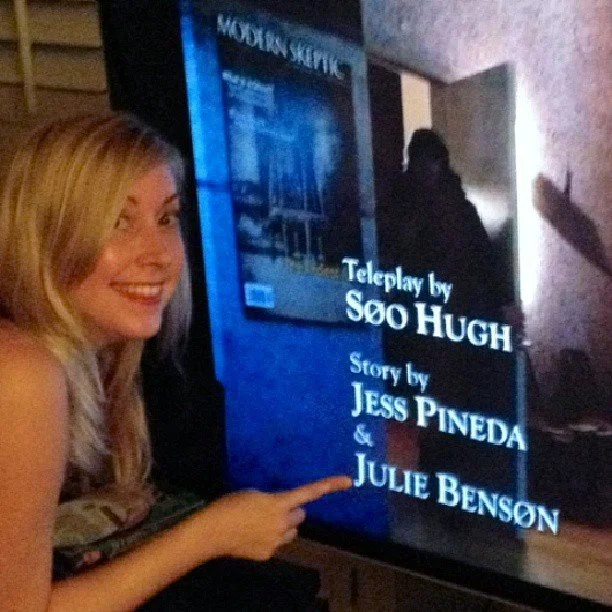
Baby’s first TV “Story By” Credit on Zero Hour “Hands”
Usually SA’s have come along with the Writer in their overall deal or have already been working for the Showrunner when a show gets picked up. Sometimes that assistant gets promoted to Writers' Assistant or Script Coordinator, and their old position is available for someone else to fill. Double win!
If you get this coveted Showrunner Assistant gig, your main job is to answer the showrunner’s phone, send/receive emails, set meetings, track expenses, get the showrunner or the show reimbursed, sometimes doing personal stuff like scheduling dentist appts or letting a repair person into their house… you know, the usual assistant fare. But you also must be observant and able to track material. The studio/network will ask you when they can expect story areas/outlines/scripts/cuts, so it’s your job to talk to their assistants and keep them apprised but do so at the protection of the show/showrunner’s schedule. You might attend meetings with the Showrunner to take notes and/or make sure if meetings are discussed, you’re ready to help coordinate one. Oh, and you’re also in touch with Production for all the questions on set that need to be lobbed at your boss.
You’re also kind of the de facto “supervisor” of the Writers' PA – you work with them to manage the office, etc.. You’ll also coordinate with the Script Coordinator on material distro. You’ll read material for staffing for the Showrunner – giving them your list of names you liked to help lessen their load. If you see stuff like “Thick skin” “High stress environment” on the job requirements… run! OK, don’t really, but ask them SPECIFICALLY what that means. I saw that disclaimer on nearly every job listing back in my day but YMMV (your mileage may vary).
Also, the Showrunner might have projects in development, general meetings, lunches outside the office, set visits, etc… Guess who’s in charge of keeping track of all that? Yep, you. Basically you should have good communication with the Writers, the Studio, the Network, and Production once up and running. It’s a busy job but a great way to learn what a Showrunner handles and the various ins/outs of multiple departments.
WRITERS’ ASSISTANT:
I was lucky enough to be promoted from Showrunner Assistant to Writers’ Assistant by Zack Estrin on “Once Upon a Time in Wonderland”, the short-lived ABC spin-off from the popular “Once Upon a Time” series. It was a fun room with brilliant writers who never made me feel lesser than and even took some of my suggestions to the board. I shared that job with another WA and we traded off on even/odd episodes in the room. This is probably unheard of today as most Writers' Assistants are also expected to do double duty as the Script Coordinator or Showrunner Assistant. Something I highly discourage for a multitude of reasons but I hear is still happening… And when you read the duties involved in this job, you’ll be just as flummoxed as me as to how a studio or network could demand such a thing.
You are now in the room where it happens, whether it be physically sitting at the writer’s room table, online, or at a desk in the back of the room taking down the notes of the day. Brush up on your typing skills, you gotta be FAST to get it all down as most rooms frown on recording conversations so you can transcribe later. And like with the SA or PA gigs, have your sample(s) ready because if an opportunity comes up to freelance an episode or have a writer read your material – YOU BETTER BE READY. If you are still working on your first script etc… you’re already behind. But if you’re lucky enough to land the gig, make sure you’re working on that pilot in your off time.
You must be a good listener to do this job and I believe you also should want to become a writer in a room someday. These are coveted positions where you can learn, make connections, and hopefully do such a great job and be such a great person, the writers/showrunner want to give you a freelance script or hire you as a SW the next season. It’s not guaranteed you’ll get an episode or a promotion, but you’ll be ready if the opportunity presents itself.
Duties include: Tracking storylines, character arcs, episode tentpoles, taking pics of the white boards or index card corkboard, cleaning up the room after the end of day, typing up the notes and emailing them out to the writers. You are the keeper of all the knowledge – a good WA will remember all the details and track character arcs, jumping in to remind the writers when necessary.
You’re gaining huge amounts of intel about writing, office politics, etc… so, sponge it up. WA’s can also be in charge of the social media accounts (in tandem with s/n input). They can be asked to sit in on notes calls or other production meetings to take notes, but they are usually focused on the room notes only. This is a wonderful opportunity to be face to face with writers on a daily basis. You’ll get to know A LOT about them all and hopefully, your personality and input will shine through.
SCRIPT COORDINATOR:
Whew, ok. This might have been the toughest job I had when I was given the chance by Rina Mimoun and K.J. Steinberg to be the Script Coordinator on “Mistresses”. It’s a very technical job that isn’t just checking for grammar and punctuation on scripts. In fact, I’m planning a whole blog entry devoted just to script coordinating soon. And don’t get it confused with Script Supervisor or “Scripty” on set. That’s a whole different ball of wax. Script Coordinators are in charge of script distro and this could include up to hundreds of execs, cast, and crew members.
In 2018, Script Coordinators and Writers' Assistants gained the ability to join IATSE Local 871 which was much overdue and well deserved. This provides much needed health benefits, pension plans, and minimum compensation. And as you’ll see, the job entails much more besides editing typos on scripts before they go to Production.
You’re the conduit between the Writers’ Room and Production. You’re tracking continuity, coordinating with BS&P (Broadcast Standards & Practices responsible for the moral, ethical, and legal implications of the program that the network airs). In other words, nudity, language, and general content that isn’t in line with their standards. This isn’t about legalities or product placement or character names, that all comes through the CLEARANCES department, and if they have an issue with a Coke bottle in the scene, you have to tell the Showrunner.
You’re tracking revisions for each draft with changes clearly marked with an asterisks (*) and a new color listed on the cover and header of each distro. You distro a “pages” version with only the revised pages in a pdf, and a “collated” version that has all the revision colors in it. As you can see, this job is more than just twiddling your thumbs until a script comes in and then checking it for typos before you hit SEND ALL. For a comprehensive book on the “how-to” for Script Coordinating check out Sean Waugh’s amazing book, “Everything Sucks and I Hate Everyone: The Complete Guide to Script Coordinating”. I wish I had this book when I was doing this job, but got it recently to check out the tips and it’s worth every penny.
LOWER LEVEL WRITERS:
Congrats, the hierarchy kinda starts all over again! But being a STAFF WRITER doesn’t mean you’re a “Baby Writer” (ew). I had worked for almost a decade at various positions in film and TV before I got my first SW gig on “The 100”. It doesn’t mean it’s your first rodeo, it means it’s your first year or two starting out as a paid writer.
Staff Writers get paid a weekly rate, and until 2023, they didn’t get paid for their first script. I’m so glad the strike was able to wrangle this out of the studio’s hands. It was so demoralizing getting our first script only to know we weren’t getting the same pay as everyone else in the room. Oh, and writing teams SHARE a paycheck, but that’s, say it with me, a topic for another blog post. If you want to see current numbers check out the WGA MBA here: WGA 2023 Schedule of Minimums.
Getting your foot in the door is a HUGE step and helps you move to the next level: STORY EDITOR. These writers used to have a year or two under their belt. Nowadays… who knows. Oh, and you’re not editing scripts like a Script Coordinator, it’s a title that means you’ve “advanced” to the next level.
After that, the next step would be to move up to EXECUTIVE STORY EDITOR (ESE), which is the last of the writer levels considered to be “lower level”. My three-year contract on “The 100” allowed me to nab all three lower level titles so that when I was hired by John Wirth for Netflix’s “Wu Assassins” I joined the elite rank of…
MID-LEVEL WRITERS:
Once you’ve proven yourself at the lower levels, you enter another competitive area – the mid-level. Jobs include: CO-PRODUCER, PRODUCER, AND SUPERVISING PRODUCER. Once you get that “Producer” title in your level, that means a bump in pay and perhaps a producer fee on top of that. The mid-level bottleneck is real. Shawna and I got caught in this level and haven’t found our way out of it.
That’s not to say the lower level jobs are any easier to obtain, but once you reach this level, studios have found multiple reasons to skip hiring at this tier altogether. For one, there’s not a specific mandate in the MBA to hire at this level. They state (for 13+ eps) hiring a minimum of 6 writers total, 3 must be writer-producers. But notice it doesn’t specify mid-level, so those usually end up being upper level since the Showrunner can depend on them to help run the room, etc… Mid-level writers become a luxury most productions can no longer afford.
Sure, it’s cheaper to hire 2-3 lower level writers but where do they go once they advance to this rung? Another bottleneck that’s actually more of a black hole. I believe studios think mid-level writers aren’t experienced enough to justify the upper level costs. It’s a huge oversight and underestimation of the importance of this level who comes armed with scripts, set experience, and post experience under their belt.
UPPER LEVEL WRITERS:
Upper level positions: CO-EXECUTIVE PRODUCER (Co-EP), EXECUTIVE PRODUCER (EP), and at the toppermost of the top, the SHOWRUNNER(S). They depend on their Co-EP and EP to help them with various duties ranging from taking over some of the production meetings to helping run the room when the Showrunner has to write or attend meetings.
Your pay increases again according to your producers fees on top of your script fees and weekly. Once at this level, you’ll be ready to run your own show in no time. (Listen, some people run shows who have NEVER done the writer’s room gauntlet, and more power to them, I guess.) But as you can see, the levels were meant to help manage expectations and experience. The more you work, the more your Showrunner sends you to set, to post, etc… the more you learn, the better you’ll be at the job once you’re in the driver’s seat. But again, things have shifted quite a bit.
Say what you want about titles and levels, there was a system in place to help a writer from assistant to Showrunner learn all the ins and outs not only of writing but of production, not to mention working for a studio, network, or streamer. These are managerial jobs that are in charge of MILLIONS of dollars. It only makes sense you want the best, most experienced person at the helm. But maybe that’s just me…
The sad part about writer’s rooms is that many are short lived. One of the best rooms I was ever in was for Season 3 of “Lore” run by Sean Crouch. We worked for 12 weeks and the show never got picked up to air, but you won’t see that show listed in my IMDB credits. So, just know that when judging a writer on their experience – you never know where they’ve been or what they’ve learned.
No matter what level you’re at, keep your samples ready. And if you want some suggestions on writer supplies or books I actually use — check out my Amazon Storefront where I’ve curated a nice list and am always adding more…
I hope this helped pull the veil away from the closed door of the writer’s room. They can be so much fun and full of creativity, but they can also be a cesspool of toxicity… again, that’s for another blog entry. But no matter the level, you can see how much each position means to the show and how as a team, they all help to bring a series to life. I wish you good luck on your journey to becoming a professional TV writer whether it be for network, cable, streaming, or verticals, just know you’re entering a field in flux. May the odds be ever in your favor. The old model wasn’t perfect, but it wasn’t broken entirely. It gave writers a chance to grow, learn, and fail. The system has been dismantled and we’re all paying the price. I hope calmer studio heads prevail and we rebuild a model that is sustainable before there’s no one left who knows how to run a show. Until then, write your script, we need voices from all walks of life in these rooms. I can’t wait to hear your story.